
“You did not choose me, but I chose you and appointed you so that you might go and bear fruit—fruit that will last—and so that whatever you ask in my name, the Father will give you.” (John 15:16, NIV)
The Church has always advanced through men and women who responded to God’s call to serve and sacrifice for the expansion of His Kingdom. From Peter and Paul, who established the early Church through courageous preaching, to Stephen, whose witness strengthened the spread of the Gospel, and reformers and revivalists such as Martin Luther, John Wesley, and Evan Roberts, God has consistently used committed believers to accomplish His divine purpose. Significantly, many of these men and women began serving God while they were still young, demonstrating remarkable faith, conviction, and courage.
Today, as the Church faces growing challenges such as secularism, digital distractions, moral decline, and weakening spiritual commitment, an important question confronts us: What role do today’s youth play in fulfilling the apostolic mandate?
Jesus provides the answer in John 15:16. He reminds His followers that they have been chosen and appointed to bear lasting fruit. This calling is not reserved for one generation alone; it extends to the youth of today, whom God continues to raise for His Kingdom purposes.
Today’s young people are energetic, educated, innovative, and technologically skilled. They occupy strategic spaces in schools, universities, workplaces, communities, and digital platforms where important conversations about identity, purpose, morality, and faith take place. These environments present unique opportunities to influence lives with the Gospel.
Contrary to common misconceptions, many young people remain spiritually receptive and are searching for meaning, purpose, and a genuine relationship with God. When intentionally discipled and mentored, they readily respond to His call and can become effective instruments for advancing His Kingdom. The challenge, however, is that in many places, church life is often reduced to programmes and activities rather than intentionally preparing young people for ministry and mission.
The responsibility therefore rests first with the youth themselves. They must recognise that they are not merely the Church of tomorrow but active participants in God’s mission today. They must pursue spiritual maturity through prayer, Bible study, worship, fellowship, and holy living so that they remain firmly rooted in Christ despite the distractions of the present age.
Young people must also embrace evangelism and discipleship as central to their calling. Positioned on campuses, in workplaces, within communities, and across digital platforms, they have unparalleled opportunities to share the Gospel with their generation. Their influence should be seen not only in words but also through lives marked by excellence, integrity, humility, innovation, and faithful service wherever God places them.
At the same time, the responsibility does not rest solely on the youth. Church leadership must intentionally nurture, mentor, and equip the next generation, following the biblical examples of Moses and Joshua, Elijah and Elisha, and Paul and Timothy. Effective leadership creates opportunities for young people to grow, serve, and lead under godly guidance.
Church leaders must also understand the realities confronting today’s youth. Rather than merely criticizing or overlooking them, they must listen, guide, encourage, and patiently walk alongside them. A thriving church is one that intentionally creates room for younger generations to contribute meaningfully to ministry while grounding them in sound biblical teaching and spiritual discipline.
The apostolic mandate is not the responsibility of one generation alone. It is fulfilled when older and younger believers work together in unity. The older generation offers wisdom, experience, and spiritual guidance, while the younger generation brings energy, creativity, innovation, and fresh perspectives. Together, they strengthen the Church and advance the mission of Christ more effectively than either generation could accomplish alone.
The Church must therefore never underestimate the potential of its youth. The future strength of the Church depends largely on how faithfully it equips today’s young people for ministry and mission. Christ’s words still echo across the generations: “I chose you and appointed you.” That calling remains as relevant today as it was when it was first spoken.
The apostolic mandate remains unfinished. The harvest is still plentiful, and the labourers are still needed. As the Church intentionally invests in its youth and young people wholeheartedly embrace God’s call, together they will bear lasting fruit and continue advancing His Kingdom until Christ returns.
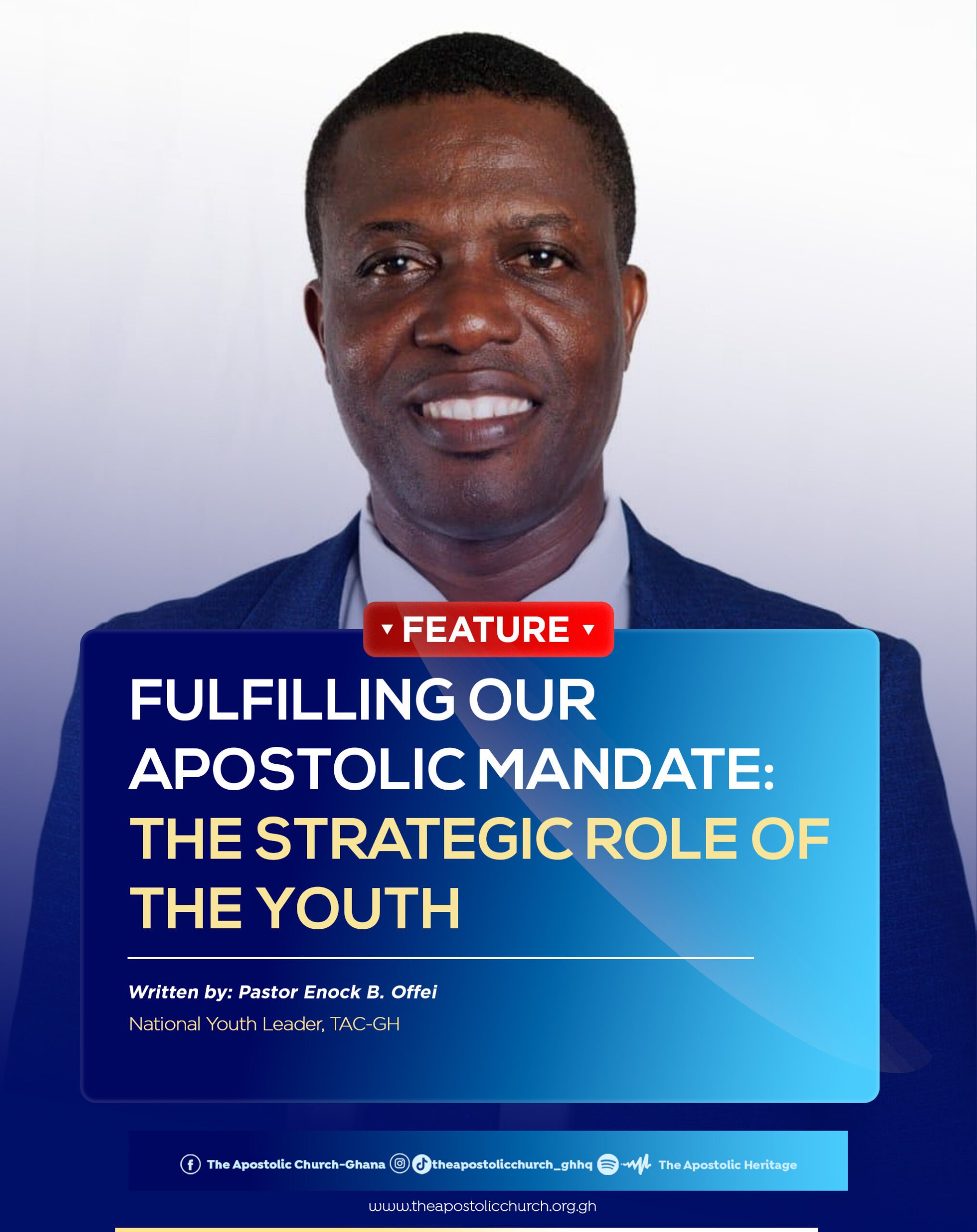
Written by: Pastor Enock B. Offei
National Youth Leader